History
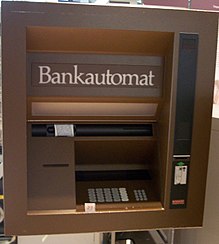
The idea of out-of-hours cash distribution developed from bankers' needs in Japan, Sweden, the United Kingdom, and the United States. A Japanese device called the "Computer Loan Machine" supplied cash as a three-month loan at 5% p.a. after inserting a credit card. The device was operational in 1966. However, little is known about the device.
Adrian Ashfield invented the basic idea of a card combining the key and user's identity in February 1962. This was granted UK Patent 959,713 for "Access Controller" in June 1964 and assigned to W. S. Atkins & Partners who employed Ashfield. He was paid ten shillings for this, the standard sum for all patents. It was originally intended to dispense petrol but the patent covered all uses.citation needed
In the US patent record, Luther George Simjian has been credited with developing a "prior art device". Specifically his 132nd patent (US3079603), which was first filed on 30 June 1960 (and granted 26 February 1963). The roll-out of this machine, called Bankograph, was delayed by a couple of years, due in part to Simjian's Reflectone Electronics Inc. being acquired by Universal Match Corporation. An experimental Bankograph was installed in New York City in 1961 by the City Bank of New York, but removed after six months due to the lack of customer acceptance. The Bankograph was an automated envelope deposit machine (accepting coins, cash and cheques) and did not have cash dispensing features.
A cash machine was put into use by Barclays Bank in its Enfield Town branch in North London, United Kingdom, on 27 June 1967. This machine was inaugurated by English comedy actor Reg Varney. This instance of the invention is credited to the engineering team led by John Shepherd-Barron of printing firm De La Rue, who was awarded an OBE in the 2005 New Year Honours. Transactions were initiated by inserting paper cheques issued by a teller or cashier, marked with carbon-14 for machine readability and security, which in a later model were matched with a six-digit personal identification number (PIN). Shepherd-Barron stated "It struck me there must be a way I could get my own money, anywhere in the world or the UK. I hit upon the idea of a chocolate bar dispenser, but replacing chocolate with cash."
The Barclays–De La Rue machine (called De La Rue Automatic Cash System or DACS) beat the Swedish saving banks' and a company called Metior's machine (a device called Bankomat) by a mere nine days and Westminster Bank's–Smith Industries–Chubb system (called Chubb MD2) by a month. The online version of the Swedish machine is listed to have been operational on 6 May 1968, while claiming to be the first online ATM in the world, ahead of similar claims by IBM and Lloyds Bank in 1971, and Oki in 1970. The collaboration of a small start-up called Speytec and Midland Bank developed a fourth machine which was marketed after 1969 in Europe and the US by the Burroughs Corporation. The patent for this device (GB1329964) was filed in September 1969 (and granted in 1973) by John David Edwards, Leonard Perkins, John Henry Donald, Peter Lee Chappell, Sean Benjamin Newcombe, and Malcom David Roe.
Both the DACS and MD2 accepted only a single-use token or voucher which was retained by the machine, while the Speytec worked with a card with a magnetic stripe at the back. They used principles including Carbon-14 and low-coercivity magnetism in order to make fraud more difficult.
The idea of a PIN stored on the card was developed by a group of engineers working at Smiths Group on the Chubb MD2 in 1965 and which has been credited to James Goodfellow (patent GB1197183 filed on 2 May 1966 with Anthony Davies). The essence of this system was that it enabled the verification of the customer with the debited account without human intervention. This patent is also the earliest instance of a complete "currency dispenser system" in the patent record. This patent was filed on 5 March 1968 in the US (US 3543904) and granted on 1 December 1970. It had a profound influence on the industry as a whole. Not only did future entrants into the cash dispenser market such as NCR Corporation and IBM licence Goodfellow's PIN system, but a number of later patents reference this patent as "Prior Art Device".
Propagationedit
Devices designed by British (i.e. Chubb, De La Rue) and Swedish (i.e. Asea Meteor) quickly spread out. For example, given its link with Barclays, Bank of Scotland deployed a DACS in 1968 under the 'Scotcash' brand. Customers were given personal code numbers to activate the machines, similar to the modern PIN. They were also supplied with £10 vouchers. These were fed into the machine, and the corresponding amount debited from the customer's account.
A Chubb-made ATM appeared in Sydney in 1969. This was the first ATM installed in Australia. The machine only dispensed $25 at a time and the bank card itself would be mailed to the user after the bank had processed the withdrawal.
Asea Metior's Bankomat was the first ATM installed in Spain on 9 January 1969, in downtown Madrid by Banesto. This device dispensed 1,000 peseta bills (1 to 5 max). Each user had to introduce a security personal key using a combination of the ten numeric buttons. In March of the same year an ad with the instructions to use the Bancomat was published in the same newspaper.
Docutel in the United Statesedit
After looking firsthand at the experiences in Europe, in 1968 the ATM was pioneered in the U.S. by Donald Wetzel, who was a department head at a company called Docutel. Docutel was a subsidiary of Recognition Equipment Inc of Dallas, Texas, which was producing optical scanning equipment and had instructed Docutel to explore automated baggage handling and automated gasoline pumps.
On 2 September 1969, Chemical Bank installed the first ATM in the U.S. at its branch in Rockville Centre, New York. The first ATMs were designed to dispense a fixed amount of cash when a user inserted a specially coded card. A Chemical Bank advertisement boasted "On Sept. 2 our bank will open at 9:00 and never close again." Chemical's ATM, initially known as a Docuteller was designed by Donald Wetzel and his company Docutel. Chemical executives were initially hesitant about the electronic banking transition given the high cost of the early machines. Additionally, executives were concerned that customers would resist having machines handling their money. In 1995, the Smithsonian National Museum of American History recognised Docutel and Wetzel as the inventors of the networked ATM.
By 1974, Docutel had acquired 70 percent of the U.S. market; but as a result of the early 1970s worldwide recession and its reliance on a single product line, Docutel lost its independence and was forced to merge with the U.S. subsidiary of Olivetti.citation needed
Wetzel was recognised by the United States Patent Office as having invented the ATM in the form of U.S. Patent # 3,761,682; the application had been filed in October 1971 and the patent was granted in 1973. However, the U.S. patent record cites at least three previous applications from Docutel, all relevant to the development of the ATM and where Wetzel does not figure, namely US Patent # 3,662,343, U.S. Patent # 3651976 and U.S. Patent # 3,68,569. These patents are all credited to Kenneth S. Goldstein, MR Karecki, TR Barnes, GR Chastian and John D. White.
Further advancesedit
In April 1971, Busicom began to manufacture ATMs based on the first commercial microprocessor, the Intel 4004. Busicom manufactured these microprocessor-based automated teller machines for several buyers, with NCR Corporation as the main customer.
Mohamed Atalla invented the first hardware security module (HSM), dubbed the "Atalla Box", a security system which encrypted PIN and ATM messages, and protected offline devices with an un-guessable PIN-generating key. In March 1972, Atalla filed U.S. Patent 3,938,091 for his PIN verification system, which included an encoded card reader and described a system that utilized encryption techniques to assure telephone link security while entering personal ID information that was transmitted to a remote location for verification.
He founded Atalla Corporation (now Utimaco Atalla) in 1972, and commercially launched the "Atalla Box" in 1973. The product was released as the Identikey. It was a card reader and customer identification system, providing a terminal with plastic card and PIN capabilities. The Identikey system consisted of a card reader console, two customer PIN pads, intelligent controller and built-in electronic interface package. The device consisted of two keypads, one for the customer and one for the teller. It allowed the customer to type in a secret code, which is transformed by the device, using a microprocessor, into another code for the teller. During a transaction, the customer's account number was read by the card reader. This process replaced manual entry and avoided possible key stroke errors. It allowed users to replace traditional customer verification methods such as signature verification and test questions with a secure PIN system. The success of the "Atalla Box" led to the wide adoption of hardware security modules in ATMs. Its PIN verification process was similar to the later IBM 3624. Atalla's HSM products protect 250 million card transactions every day as of 2013, and secure the majority of the world's ATM transactions as of 2014.
The IBM 2984 was a modern ATM and came into use at Lloyds Bank, High Street, Brentwood, Essex, the UK in December 1972. The IBM 2984 was designed at the request of Lloyds Bank. The 2984 Cash Issuing Terminal was a true ATM, similar in function to today's machines and named by Lloyds Bank: Cashpoint. Cashpoint is still a registered trademark of Lloyds Banking Group in the UK but is often used as a generic trademark to refer to ATMs of all UK banks. All were online and issued a variable amount which was immediately deducted from the account. A small number of 2984s were supplied to a U.S. bank. A couple of well known historical models of ATMs include the Atalla Box, IBM 3614, IBM 3624 and 473x series, Diebold 10xx and TABS 9000 series, NCR 1780 and earlier NCR 770 series.
The first switching system to enable shared automated teller machines between banks went into production operation on 3 February 1979, in Denver, Colorado, in an effort by Colorado National Bank of Denver and Kranzley and Company of Cherry Hill, New Jersey.
In 2012, a new ATM at Royal Bank of Scotland allowed customers to withdraw cash up to £130 without a card by inputting a six-digit code requested through their smartphones.


Comments
Post a Comment